←August→
| Sun |
Mon |
Tue |
Wed |
Thu |
Fri |
Sat |
| |
|
|
|
|
|
1 |
| 2 |
3 |
4 |
5 |
6 |
7 |
8 |
| 9 |
10 |
11 |
12 |
13 |
14 |
15 |
| 16 |
17 |
18 |
19 |
20 |
21 |
22 |
| 23 |
24 |
25 |
26 |
27 |
28 |
29 |
| 30 |
31 |
|
|
|
|
|
|
|
Thu, Aug 13, 2026 7:20 pm
Symlinks on Linux
To create a
symbolic link
(symlink), aka soft link, on a
Linux system, you can
use the ln command with
the -s option, i.e., ln -s, followed by the target
file path and the name you wish to use for the symbolic link. The
-s option specifies that the link should
be "soft" or symbolic (omitting this creates a hard
link). You can view existing symlinks with the ls command with the
-l option and then piping the output through the grep command with the
-l or --long option to obtain more detailed
information. Since the permission string for files or directories will
begin with the letter "l", you can limit the output with ls -l |
grep "^l". E.g.:
alice@Wonderland@Serenity:~/Documents$ ln -s ~/Pictures/Phone/PXL_20260715_202210365.jpg erin.jpg
alice@Wonderland@Serenity:~/Documents$ ls -l | grep "^l"
lrwxrwxrwx  1 alice@Wonderland domain users@ad.moonwillowwoods.com        75 Aug 14 15:03 erin.jpg -> /home/alice@Wonderland/Pictures/Phone/PXL_20260715_202210365.jpg
alice@Wonderland:~/Documents$
You can link an entire directory with a symlink. E.g., you could point a
local logs folder to a folder elsewhere on the system, even one
on another drive. E.g., ln -s /var/log/app_logs ./logs.
If you wish to find all of the symlinks in the current directory and
all its subdirectories, you can use the command find . -type l.
The -type l flag instructs the
find command to look
just for links. To see the full, absolute path of where a specific link points
you can use the
readlink command, e.g.,
readlink -f filename
where filename is the name of the symlink. E.g.:
alice@Wonderland:~/Documents$ readlink -f erin.jpg
/home/alice@Wonderland/Pictures/Phone/PXL_20260715_202210365.jpg
alice@Wonderland:~/Documents$
You can remove a symlink with the unlink command
followed by the symlink name.
alice@Wonderland@Serenity:~/Documents$ unlink erin.jpg
alice@Wonderland:~/Documents$
You could also use the rm
command. E.g., if you created a symlink named shortcut.txt, you could
remove that shortcut with rm shortcut.txt. Never add a trailing
slash (/) when removing a directory symlink, or you risk
deleting the contents inside the actual target directory.
[/os/unix/linux]
permanent link
Thu, Aug 06, 2026 3:29 pm
Registry location for Advanced Diary registration information
The Advanced Diary journaling/diary
program from CSoftLab stores its
license information in the
Windows registry at
HKEY_CURRENT_USER\Software\CSoftLab\Advanced Diary. When you
install the software, you will have a 30-day trial period and the
LicenseCode and LicenseName keys will not have
any values set. You can see the values using the Microsoft Windows registry
editor regedit.exe.
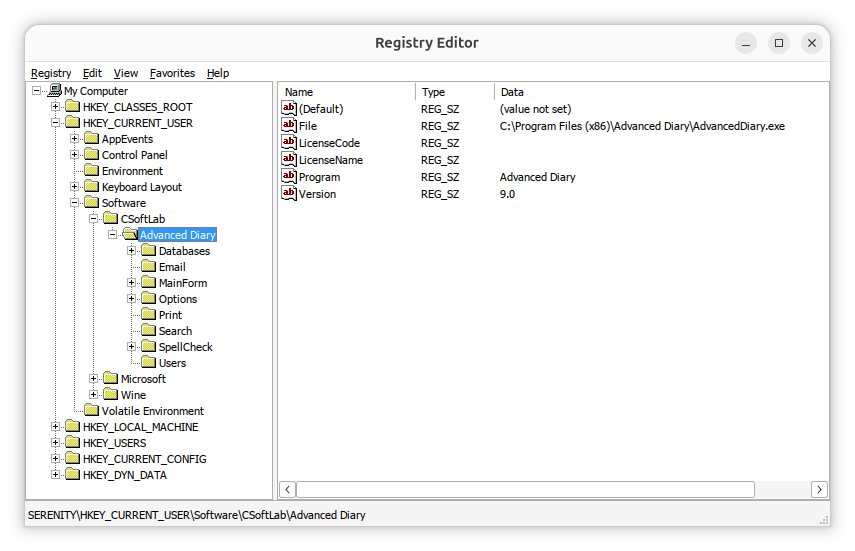
If you need to view the license information, you can navigate to the
HKEY_CURRENT_USER\Software\CSoftLab\Advanced Diary key in
the registry using the registry editor or you can
open a command prompt window and
issue the following reg query commands.
C:\>reg query "HKCU\SOFTWARE\CSoftLab\Advanced Diary" /v LicenseName

HKEY_CURRENT_USER\SOFTWARE\CSoftLab\Advanced Diary
    LicenseName    REG_SZ    John Doe


C:\Users\Lisa>reg query "HKCU\SOFTWARE\CSoftLab\Advanced Diary" /v LicenseCode

HKEY_CURRENT_USER\SOFTWARE\CSoftLab\Advanced Diary
    LicenseCode    REG_SZ    VN37-H79K-28ZZ-XMMUMM9XX9


C:\>
You can extract the information from the registry by right-clicking on the
Advanced Diary entry in the registry and choosing Export
and then saving the information to a .reg registry file. That will save all
of the registry information for Advanced Diary. You can then delete all
but the lines that are like the ones below, if you only need the license
entries in the registry.
Windows Registry Editor Version 5.00
[HKEY_CURRENT_USER\SOFTWARE\CSoftLab\Advanced Diary]
"LicenseName"="John Doe"
"LicenseCode"="VN37-H79K-28ZZ-XMMUMM9XX9"
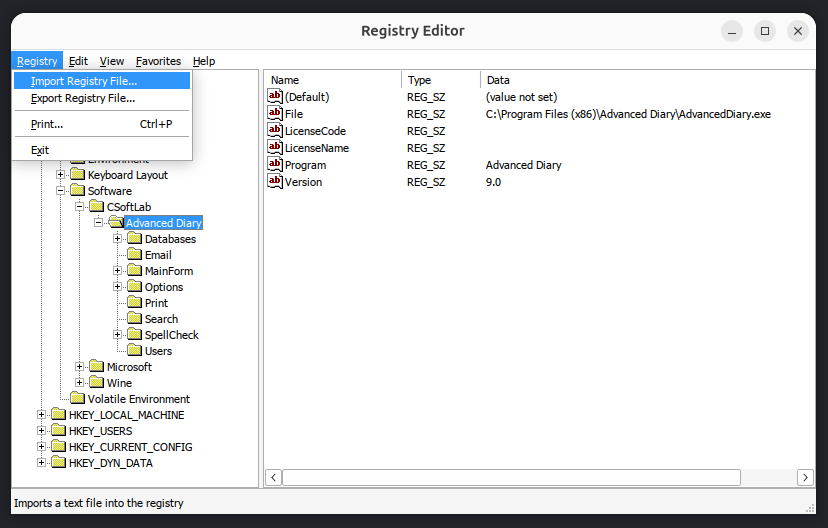
You can then import the registry entries after installing Advanced Diary
on another system. You can import them by opening the registry editor and
choosing Registry and then Import Registry File.
Note: if you are transferring the registry keys to an installation of
Advanced Diary running under Wine on a Linux system, you can run the
registry editor provided by Wine by opening a
terminal window
and then setting the WINEPREFIX environment variable equal to
whatever Wine prefix you have set, if you are using one other than the
.wine one, and then running wine regedit. E.g.:
$ export WINEPREFIX="$HOME/.wine-advdiary"
$ wine regedit
If you have saved the registry values to a .reg file, e.g.
file.reg, and want to import the values from that file from
a command-line
interface (CLI), open a
command prompt window as an administrator and run
reg import "C:\path\to\file.reg". Alternatively, use
regedit /s "C:\path\to\file.reg" to import the file silently
without a confirmation prompt. To import the registry values from a
Windows system into the registry for an instance of Advanced Diary 9.0
running in a Wine prefix named .wine-advdiary on
an Ubuntu Linux system,
I used the commands below in a terminal window to import a .reg file
named AdvancedDiary_LicenseInfo.reg.
$ export WINEPREFIX="$HOME/.wine-advdiary"$ wine regedit /s "$HOME/Documents/AdvancedDiary_LicenseInfo.reg"
$
After doing so, when I clicked on Help and chose About Advanced
Diary, I saw it was registered.
Related articles:
-
Obtaining a command prompt in Windows 11
Date: August 14, 2023
-
Windows Reg Query Command
Date: October 1, 2026
-
Checking Microsoft Windows proxy server
settings
Date: January 7, 2015
-
Installing Advanced Diary on a Linux system with Wine
Date: February 24, 2026
-
Access violation when installing Advanced Diary 9.0 with Wine on a Linux system
Date: August 4, 2026
-
Advanced Diary Active Database and Backup Registry Values
Date: July 18, 2026
[/os/unix/linux/wine/AdvDiary]
permanent link
Tue, Aug 04, 2026 9:27 pm
Access violation when installing Advanced Diary 9.0 with Wine on a Linux system
I needed to install the
Advanced Diary diary/journaling program
from CSoftLab on an Ubuntu
Unix system. The application is developed only for Microsoft Windows,
so to get it to work on an Ubuntu Linux system I used
Wine, which is
free and
open-source software that allows one to run applications developed
for the Microsoft Windows
operating system
(OS) on Linux systems.
I started the installation from a
terminal window after
creating and initializing a Wine
prefix for it. But when I clicked on Install, I saw the
message "Invalid operation in GDI+ (Code: 2)". When I canceled the
installation and closed the window associated with it, I saw an error
window stating "The setup files are corrupted. Please obtain a new copy
of the program." I had encountered the same "Invalid operation in GDI+
(Code: 2)" problem many months ago (the setup file wasn't actually
corrupted, so I could ignore that message) when I installed a previous
version of Advanced Diary, version 8.0, on another system using Wine
— see Installing Advanced
Diary on a Linux system with Wine — and remembered that I
had used a shell
script then to install additional software for Wine that
would alleviate that problem. I needed Winetricks installed, so
I verified I had already installed it on this system with the which command
(you can install it with sudo apt install winetricks,
if it is not installed). I used winetricks to install gdiplus and core
fonts for Windows applications. That resolved the problem with the
"Invalid operation in GDI+ (Code: 2)", but then I saw a
"Access violation at address 75D947DC in module 'qcap.dll'. Read of address
5F505353" message every time I started Advanced Diary.
[ More Info ]
[/os/unix/linux/wine/AdvDiary]
permanent link
Fri, Jul 31, 2026 9:18 pm
Creating and using a Wine prefix on an Ubuntu Linux system
A Wine prefix is a directory that acts like a separate Windows installation.
Each prefix has its own registry, installed programs, libraries, and
configuration, providing a way to isolate applications and configure Wine
in a way that is optimal for a particular Windows application or set of
applications without affecting other Windows applications that you need
to run on the system. To create a new Wine prefix, take the following
steps:
Create a new Wine prefix
Open a
terminal
window.
-
Choose a location for the new prefix. For example:
export WINEPREFIX="$HOME/.wine-myapp"
-
Initialize the prefix:
WINEPREFIX="$HOME/.wine-myapp" wineboot
Wine will create the directory and initialize a fresh Windows environment.
[ More Info ]
[/os/unix/linux/wine]
permanent link
Mon, Jul 13, 2026 4:52 pm
Installing Discord on an Ubuntu Linux system
To install Discord on
an Ubuntu Linux system,
you can install it as a
Snap package through Ubuntu's App Center.
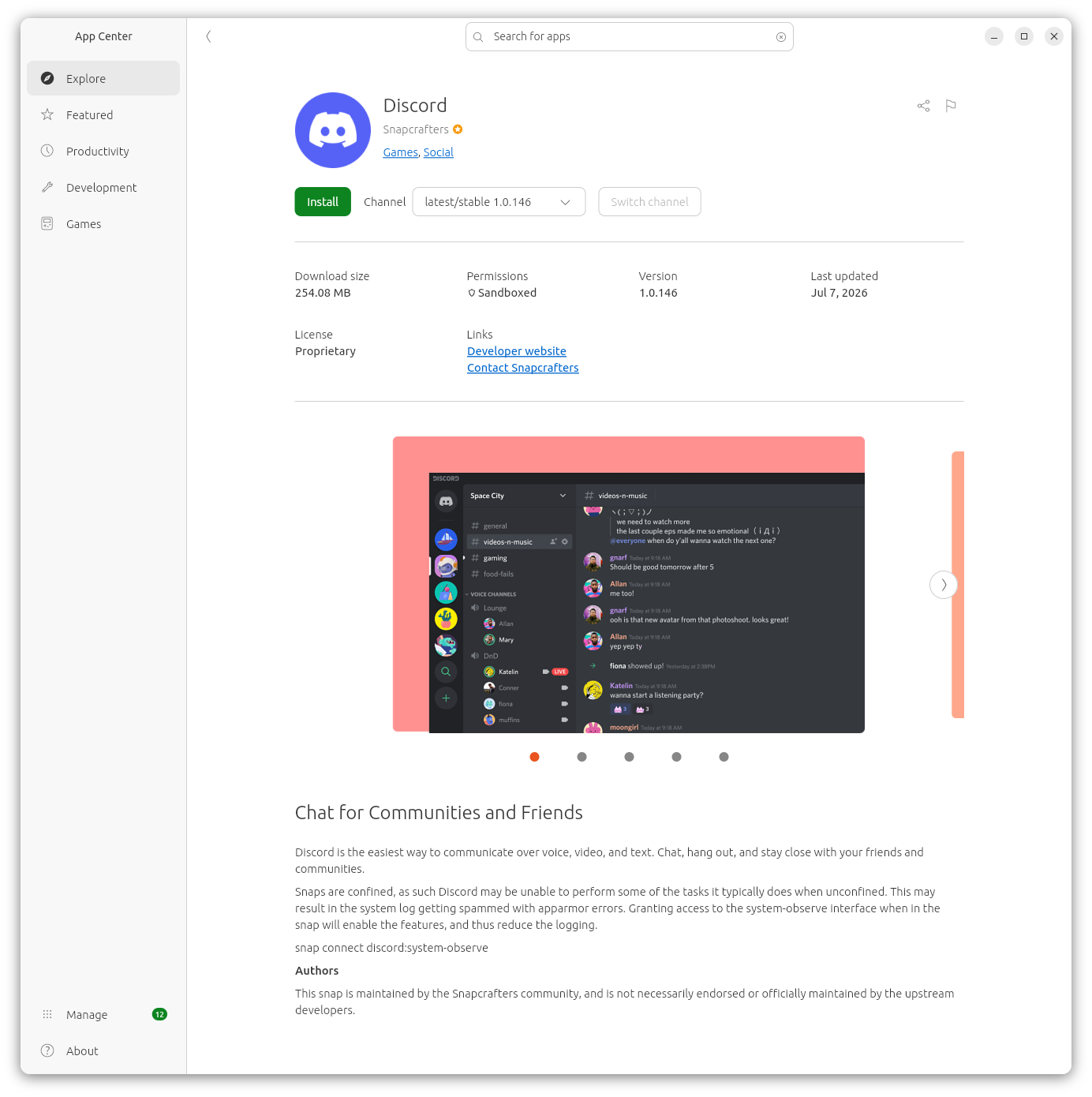
At the install screen, I saw the message below:
Snaps are confined, as such Discord may be unable to perform some
of the tasks it typically does when unconfined. This may result in the
system log getting spammed with apparmor errors. Granting access to the
system-observe interface when in the snap will enable the features, and
thus reduce the logging.
snap connect discord:system-observe
AppArmor is a
Linux kernel
security module that provides system administrators the capability to
restrict the access programs have to the system on which they run.
[ More Info ]
[/os/unix/linux/ubuntu]
permanent link
Thu, Jul 02, 2026 9:42 pm
DVDFab 13 - Unload debugger
My wife had been using
DVDFab 13 under Microsoft
Windows 11 and wanted to continue to use it for
ripping DVDs after we
converted her desktop PC to
Ubuntu Linux. DVDFab 13
seemed to be working fine after I installed it using
Wine until after I
updated Wine to version 11.0 (you can see which version of Wine is present
by issuing the command wine --version in a
Terminal window).
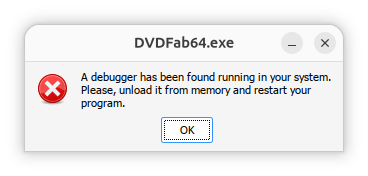
When I tried to run DVDFab afterwards, though, I saw the message
“A debugger has been found running in your system. Please, unload
it from memory and restart your program.”
When I queried
ChatGPT about the
issue, it replied “This error is usually not caused by an actual
debugger running on Ubuntu. DVDFab contains anti-debugging / anti-tamper
checks, and under Wine or Proton those checks can sometimes incorrectly
conclude that a debugger is attached.” It also stated that, for
DVDFab 13 specifically, there is an issue when trying to run the program on
later versions of Wine with the problem appearing with version 10.3 or
later. The problem occurs on newer versions, even when no
debugger is running.
I decided to install the application under Bottles, which I had previously
installed on the system with Flatpak, to see if the problem might not occur
if I tried to run the application under
Bottles, but the problem still occurred. I.e., I saw the "A debugger
has been found running in your system. Please, unload it from memory and
restart your program.” message. It took me a considerable amount of time
to resolve the problem, but I was finally able to fix the issue by disabling
DXVK and VKD3D in the settings for the DVDFab bottle.
[ More Info ]
[/os/unix/linux/ubuntu/DVDFab]
permanent link
Wed, Jul 01, 2026 9:13 pm
Remove a Flatpak
To see the Flatpaks
installed on a Linux system, you can issue the command flatpak list
in a terminal window. To remove a Flatpak from a system, find the Application
ID of the software by issuing the command flatpak list --app.
Once you have the Application ID, you can uninstall the Flatpak with the
command flatpak uninstall AppID where AppID is
the relevant Application ID. To remove all of the application's local settings
and configuration files, add the --delete-data option. E.g.,
to remove the
Bottles Flatpak, I could use the command
flatpak uninstall --delete-data com.usebottles.bottles.
alice@Wonderland:~$ flatpak list
Name             Application ID              Version Branch       Installation
Bottles          com.usebottles.bottles      63.2    stable       system
i386             …sktop.Platform.Compat.i386         25.08        system
Mesa             …esktop.Platform.GL.default 26.0.6  25.08        system
Mesa (Extra)     …esktop.Platform.GL.default 26.0.6  25.08-extra  system
nvidia-580-159-… …tform.GL.nvidia-580-159-03         1.4          system
Mesa             …ktop.Platform.GL32.default 26.0.6  25.08        system
Mesa (Extra)     …ktop.Platform.GL32.default 26.0.6  25.08-extra  system
nvidia-580-159-… …orm.GL32.nvidia-580-159-03         1.4          system
Nvidia VAAPI dr… …ktop.Platform.VAAPI.nvidia         25.08        system
Codecs Extra Ex… …ktop.Platform.codecs-extra         25.08-extra  system
i386             …Platform.codecs_extra.i386         25.08-extra  system
GNOME Applicati… org.gnome.Platform                  49           system
Yaru Gtk Theme   org.gtk.Gtk3theme.Yaru              3.22         system
gecko            org.winehq.Wine.gecko               stable-25.08 system
mono             org.winehq.Wine.mono                stable-25.08 system
alice@Wonderland:~$ flatpak list --app
Name        Application ID             Version     Branch     Installation
Bottles     com.usebottles.bottles     63.2        stable     system
alice@Wonderland:~$ flatpak uninstall --delete-data com.usebottles.bottles


        ID                                    Branch         Op
 1. [-] com.usebottles.bottles                stable         r
 2. [-] com.usebottles.bottles.Locale         stable         r

Uninstall complete.
Delete data for com.usebottles.bottles? [y/n]: y
alice@Wonderland:~$
A Flatpack may required shared "runtimes" components. When you delete
the application, those runtimes can become "orphaned", but still occupy
space on the system. You can, optionally, use the command
flatpak uninstall --unused afterwards, if that is a concern.
[/os/unix/linux]
permanent link
Sun, Jun 28, 2026 3:16 pm
Determining the default file manager application under Ubuntu
The file command
can be used on a Linux
system to determine what type of data a file holds, e.g.,
file Untitled.png. You can determine the
media type, aka
MIME type, by using
the --mime-type option for the file command. E.g.,
file --mime-type Untitled.png. You can determine which application
is the default application for opening files of that
file type using the
xdg-mime
command — the
xdg-mime program is a command line tool that can be used to determine
what application handles a particular file type. E.g., xdg-mime
query default image/png — you need to specify the filetype
in the "minor/major" format that xdg-mime expects, which is what you see
in the output of the file --mime-type command.
$ file Documents/Untitled.png
Documents/Untitled.png: PNG image data, 597 x 113, 8-bit/color RGBA, non-interlaced
$ file Documents/tea.html
Documents/tea.html: ASCII text, with very long lines (6229)
$ file --mime-type Documents/Untitled.png
Documents/Untitled.png: image/png
$ xdg-mime query default image/png
org.gnome.Loupe.desktop
$ file --mime-type Documents/Cocoa-Lead.odt
Documents/Cocoa-Lead.odt: application/vnd.oasis.opendocument.text
$ xdg-mime query default application/vnd.oasis.opendocument.text
libreoffice-writer.desktop
$
The default file
manager for Ubuntu
Linux is GNOME Files.
You can make another application the default file manager, if you like.
Some alternatives are
Thunar,
Nemo,
Krusader, or
Dolphin.
You can determine which application is the default file manager with the
command xdg-mime query default inode/directory. You can set
the default file manager with the command xdg-mime default
fmgr.desktop where fmgr is the filemanager you wish to
use.
[ More Info ]
[/os/unix/linux/ubuntu]
permanent link
Wed, Jun 17, 2026 9:08 pm
Unable to access minimized Collectorz windows
My wife and I have been using the Microsoft Windows desktop versions
of CLZ's database programs for managing
book, comic, and movie collections for many years. We've found the Collectorz
database programs to be
well-designed and very useful, but we've encountered some issues getting the
programs to work correctly on her
Ubuntu Linux system, though
I would note that the software was developed for Microsoft Windows
operating systems
and the company doesn't indicate they are supported under Linux.
One problem we encountered is that after installing the programs under
Wine, when she
opened one of the programs, e.g., Movie Collector, and then minimized it
or switched to another application with Alt-Tab, she was unable to
switch back to the Collectorz program. Alt-Tab would not work nor
would the
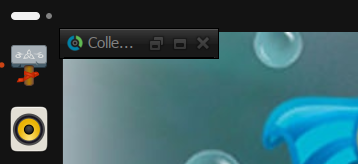
Super key plus Tab key combination. There would be a small window
at the upper, left-hand corner of the screen indicating the program was
running, but clicking on it would not allow her to enlarge the window to
work in the application again and there didn't appear to be any way to
enlarge or maximize the window.
I was able to resolve the problem with minimizing the application or
switching from it without re-creating a problem opening files by checking the
Emulate a virtual desktop option under the Graphics
tab for winecfg instead.
[ More Info ]
[/os/unix/linux/wine/collectorz]
permanent link
Sun, Jun 14, 2026 10:43 pm
Application failed to initialize NO_ANSWER_FROM_MAKEMKVCON
I had installed
MakeMKV from source files on an Ubuntu Linux system . It had been
working then, but when I tried to run the program today, I saw the
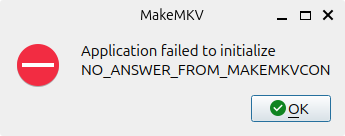
message "Application failed to initialize NO_ANSWER_FROM_MAKEMKVCON".
I had updated the operating system and other applications on the system
in the intervening months, so I knew it was possible that the upgrade changed or
removed libraries that makemkvcon depends on. I had upgraded the operating
system from Ubuntu
25.10 (Questing Quokka) to 26.04
LTS (Resolute Racoon). The error means the MakeMKV graphical
user interface (GUI) can't communicate with its backend console
process, makemkvcon. I.e., the GUI is waiting for a response from
makemkvcon and that process isn't starting or is crashing, possibly because
of a missing required dependency such as a missing or changed library file.
To try to determine if that was the case and, if so, which library might be
associated with the problem, I ran makemkvcon from a terminal window.
alice@Wonderland:~$ which makemkvcon
/usr/bin/makemkvcon
alice@Wonderland:~$ makemkvcon
makemkvcon: error while loading shared libraries: libavcodec.so.61: cannot open shared object file: No such file or directory
alice@Wonderland:~$
I was able to resolve the problem by reinstalling
MakeMKV from the source files. When I did
that and re-registered the application, it started normally.
[ More Info ]
[/os/unix/linux/ubuntu/MakeMKV]
permanent link

Privacy Policy
Contact